
How Much Does Epoxy Floor Coating Cost?
Put the question of epoxy floor cost to a few people and the answers may sit far apart, often because each is pricing a different job. This guide walks through what makes up a professional estimate, how every factor nudges the total up or down, and which items a thorough proposal ought to list.

The Short Answer
As a planning guide, professionally installed epoxy floor coatings commonly land between $6 and $10 per square foot. Taking $8 as the midpoint puts a typical two-car garage at roughly $3,200 to $4,000. Your actual price depends on floor size, the preparation your concrete needs and the coating system suited to the space, details that firm up only once someone has evaluated the floor in person.
What Affects the Cost?
Five factors explain most of the spread between one epoxy coating proposal and another.
01
Floor Size
Larger floors need more material and labor. Some expenses barely change with size, though, among them equipment transport, setup and mobilization. Across a big slab, those fixed costs form a smaller share of the total, whereas a small floor feels them more. Careful measuring gives every estimate a dependable base.
02
Concrete Condition
Oil-soaked patches, leftover sealer, cracking across the slab or a crumbling surface each add preparation ahead of coating. A structurally sound slab with no prior treatment needs much less work to reach the profile coatings require.
03
Surface Preparation
Grinding is what roughens concrete enough for a coating to grip. The slab dictates how much of it is involved; a hard-troweled finish, surface damage or a previous coating each enlarge the scope. An estimate that budgets for genuine preparation shows what a high-performing floor really costs.
04
Coating System
Single-coat applications sit at the lower end for materials. Multi-layer builds combining primer, decorative flake, a high-build base and a urethane or polyaspartic topcoat call for considerably more product. What the slab looks like and what the room must handle determine the right system, not a default package.
05
Decorative Finish
Solid colors are the simplest decorative option to apply and cost the least. Flake systems take extra material and labor to create their textured, speckled look. Metallic finishes need specialized technique and sit at the upper end of decorative pricing.
What Are You Really Paying For?
For a look at every stage of a professional coating project and why each one matters, see our step-by-step overview of how an epoxy floor goes in.
An estimate pays for the entire job: prep and application labor, grinding machines and consumables, commercial-grade materials and the judgment to select the right system for the floor at hand. Materials are only part of what the total covers.
When a quote comes in far under the others, ask what it leaves out. Thinner grinding, a reduced coat count or crack repair left off all shrink the scope; they do not deliver the same job more cheaply. Lining proposals up side by side, item against item, is how you find out what each one really covers.
Cutting prep, coats or repairs lowers the price by making the project smaller, and with use the floor tends to show it.
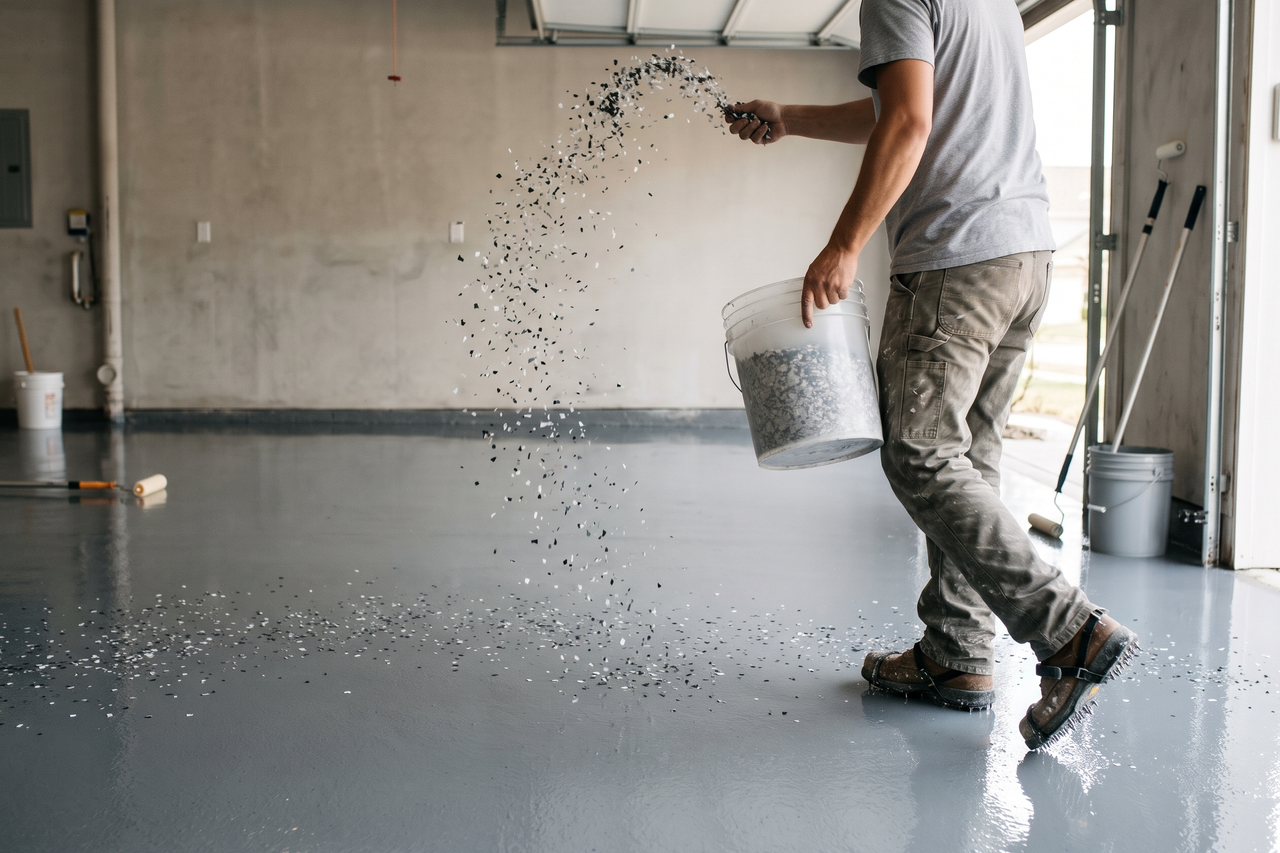
How Much Does a Garage Floor Cost?
Run the $8 planning figure against common garage sizes and you get these rough budgeting numbers.
| Garage Size | Approximate Area | Budget Figure |
|---|---|---|
| One-car | 250 sq ft | $2,000 |
| Two-car, standard | 400 sq ft | $3,200 |
| Two-car, oversized | 500 sq ft | $4,000 |
| Three-car | 750 sq ft | $6,000 |
*The figures above come from multiplying square footage by an $8 planning rate; that rate falls near the middle of the $6–$10 range seen on professional jobs. They are budgeting aids, not quotes. Real pricing hinges on the condition of your concrete, the prep it requires and the chosen coating system, and it can be set only after an in-person look at the floor.
Is It Worth the Cost?
Think about everything a garage floor endures: tires rolling across it, drips from parked cars, dropped tools and gear dragged over a surface that was never meant to stay good-looking. Bare concrete absorbs all of it.
Bare concrete is porous. Liquids work in and stain it, discoloration deepens with use, and mechanical stress wears the surface away. If the concrete under a coating was never properly profiled, the bond may not hold reliably, and lifting or peeling can leave the owner paying for the same floor again.
Compared with bare concrete, a coating picked for the space’s real conditions does a far better job of holding liquids at the surface for cleanup. That edge is most valuable in garages, workshops and utility rooms, where looks and easy cleaning matter.
What Should Be Included in Your Quote?
A thorough proposal covers the full scope of work, not just the coating material. When reviewing one in writing, make sure each of these items appears:
- Slab evaluation — moisture readings plus a hands-on look at the concrete before anything is planned
- Surface profiling — grinding with diamond tooling or shot blasting so the concrete has texture for the coating to grip
- Crack and spall repair done while the slab is still bare
- Primer selection guided by moisture readings and how absorbent the slab is
- Base coat and broadcast — color layer plus decorative flake, put down the way the selected system requires
- Topcoat application fitted to the traffic and conditions expected on the floor
- Site cleanup that deals with grinding dust and prep debris and hauls away the waste
- Cure-stage guidance outlining what the floor can tolerate at every point after the final coat goes down
If a written proposal skips something on this list, find out from the contractor how that item will be handled before signing.
Frequently Asked Questions
Q: Why do epoxy floor estimates vary so much between contractors?
Scope accounts for most of the gap. Lighter prep, fewer coats or no crack-repair allowance all mean less work, and a lower number reflects that rather than any extra efficiency. Going through proposals line by line shows what each truly includes.
Q: Is the per-square-foot price usually lower on larger floors?
Often, yes. Mobilization expenses such as hauling equipment and setting up the site don’t rise with floor size, so a large slab divides them over more square feet, while a small floor carries a heavier share.
Q: Is the $6–$10 range a sensible budgeting starting point?
Yes, as a starting point. Applying the $8 midpoint through the garage table above gives a ballpark tied to size alone. It cannot reflect your concrete’s condition, the prep involved or the right system, so a figure you can rely on requires an in-person look at the floor.
Q: To what degree can the slab's condition change the price?
In some cases, by a lot. Heavy repairs, taking off an old coating or widespread patching add labor and materials to the prep stage, and on a badly compromised slab preparation can become a major part of the estimate.
Q: What costs usually sit outside a flooring proposal?
The owner usually handles moving vehicles, equipment and stored belongings out before work starts. Structural defects in the slab, drainage fixes and repairs unrelated to the coating typically sit outside a standard flooring proposal.
Q: What is usually behind a higher estimate?
A higher number often points to a broader scope: extra coats, better materials or a system made for harder conditions. Price by itself settles nothing, so ask what is included and what makes that system right for your floor. A clear, specific reply is a good sign the recommendation was thought through.
Ready to Get a Real Number for Your Floor?
Serving Searcy, AR and surrounding areas. Describe your floor and request a customized quote shaped by what the concrete actually needs.