
Epoxy Floor Installation: What to Expect
Installing an epoxy floor is a series of steps that rely on one another. The inspection shapes the preparation plan, the preparation determines how firmly the coating bonds, and how the cure is managed influences the way the floor behaves when it is finally put to work.

The Short Answer
The job unfolds in five stages: a concrete evaluation, grinding and cleaning, repair of visible damage, layer-by-layer coating application and curing of the finished floor. Your installer sees your slab in person and talks through its plan before anything begins.
What Happens During Professional Epoxy Floor Installation?
Those five stages follow a fixed order, and each one lays groundwork for what comes after.
01
Evaluate the Concrete
First, your installer looks at the slab firsthand. Moisture readings, checking for old sealers or coatings and examining the surface up close give a clear picture of the floor, and that picture steers the choice of coating as well as the scope of prep.
02
Prepare the Surface
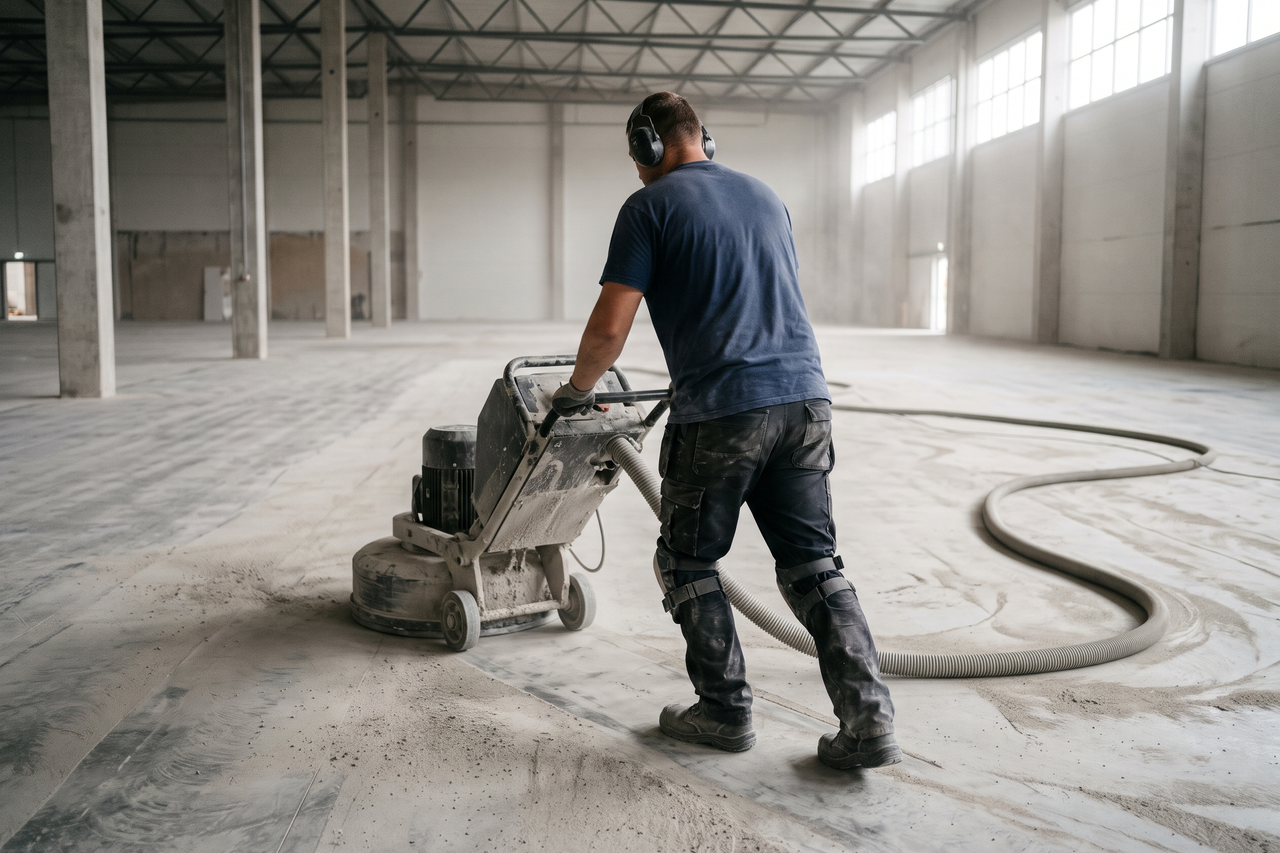
For epoxy to grip, the concrete must be opened up mechanically to create texture. That profile comes from diamond grinding or shot blasting, which takes off the dense upper skin. The effort this stage needs depends on what the slab has been through, existing coatings and anything stuck to the surface.
03
Repair Cracks and Defects
Once the concrete is bare, attention turns to cracks, spalls and other damage. Doing repairs ahead of any coating keeps every defect in plain view, so each one is judged and treated on its own.
04
Apply the Coating System
Each layer goes on in the manufacturer’s sequence: primer, base coat, a decorative broadcast if one is planned, and the topcoat. No layer is added until the one beneath it reaches the proper set condition.
05
Allow the Floor to Cure
After the last coat, the floor takes on more use step by step. Walking comes first, vehicles next, and full chemical resistance is the final milestone. Your installer describes every threshold before the project starts.
What Makes a Professional Installation Different?
Slabs that look alike from the doorway may turn out to be very different on closer inspection. The first might hide elevated moisture, leftover coating and active cracking, and the second could be dry and solid throughout. A professional evaluation notices that contrast instead of treating all concrete as the same job.
An early coating failure usually leaves clues about its cause. Preparation is often part of the problem, alongside moisture, product choice and installation conditions. Getting each one right hands the coating you choose a better foundation for long-term performance.
If you are ready to look at your own slab, describe the floor and how it is used to request a customized quote.
Why Concrete Preparation Matters
For more detail on grinding methods, crack repair and moisture testing, our in-depth look at readying concrete for a coating explains how each step is done in practice.
Epoxy bonds to concrete mechanically. Grinding exposes open pores, and the liquid coating works down into that roughness and locks on. Concrete that is sealed, painted or troweled glass-smooth gives the coating almost nothing to grab, so on an unprepared slab the bond starts out weak.
How much prep a floor needs depends on its past. New, unsealed concrete is nothing like a slab buried under old paint, mastic or layer after layer of sealer, and your installer decides the preparation scope based on what the surface really shows, not on one fixed standard.
Repairing Cracks and Surface Damage
Repair work happens with the slab completely uncovered. Stripping prior coatings and profiling the concrete reveal how far cracks and weak areas really extend, so each can be fixed before primer hides it and makes access harder.
No two cracks are assessed alike. A shallow, stable hairline gets different treatment from a crack that is widening or has one edge higher than the other. Where there is movement, a flexible filler or a more involved repair may be needed, and your installer describes the approach for each defect before moving ahead.
Coating over a crack that has not been treated leaves the actual problem in place. Edges of the finish can start to lift, and a crack that keeps shifting may eventually show up through the new surface. Defects are best handled while the concrete is still bare.
Applying the Epoxy Coating System
For durability, UV behavior and application compared head to head, see our epoxy versus polyaspartic comparison.
With prep complete, the coating system goes on one layer at a time. Primer sinks into the profiled concrete and gives everything above it a stable footing. Decorative chips, if the design includes them, get tossed across the wet base coat and settle in before it sets.
Shoes, tools, vehicles and cleaners all wear on the topcoat first. Product, coat count and film thickness follow what the room requires, which means a busy commercial floor with heavy machinery and regular chemical splashes calls for another build entirely than a garage used lightly at home. Temperature and humidity are watched throughout, since both influence how each coat builds and bonds.
How Long Does Epoxy Flooring Take to Cure?
Curious what moves a project’s price? Our overview of epoxy floor coating pricing explains the roles floor size, condition and system choice play.
A newly coated floor gains readiness in steps, beginning with foot traffic, moving to vehicles and ending with full chemical resistance. Pushing heavier use onto it too early risks marks or damage that are tough to undo.
Chemical resistance is complete only when cross-linking has finished through the whole film. Hardness to the touch can arrive earlier, so a firm feel is not proof of full readiness. Because the progression depends on floor size, condition, preparation and the system used, your installer walks you through what to expect beforehand.
Frequently Asked Questions
Q: What does inspecting the concrete uncover before the project starts?
Everything about the project flows from the inspection. Moisture tests, a record of any existing coatings or sealers, a crack survey and a reading of the present surface profile point to the appropriate system and the preparation the slab calls for. Skip that information and a recommendation becomes guesswork.
Q: What problems can poor surface preparation cause?
Coatings depend on the texture that grinding produces. If grinding leaves the surface under-textured, overly smooth or still carrying old coating residue, adhesion suffers before the first coat goes on. Early peeling can have several causes: preparation is often part of the problem, alongside moisture, product choice and installation conditions.
Q: Is coating over an old floor finish ever an option?
Sometimes; it depends on what is already on the slab. A coating that is firmly bonded, shows no lifting and is compatible with the new product may work after an on-site evaluation, while one that is flaking or separating generally has to come off first. Expect your installer to inspect what is there and lay out the options.
Q: How can I tell when the floor is ready for walking, vehicles and chemical exposure?
Before work begins, your installer explains every stage: the point at which walking is fine, when vehicles may return and when full chemical resistance has developed. How that sequence plays out hinges on floor size and condition, the prep required and which system goes down.
Q: If a crack appears in the finished floor, is the coating at fault?
Not necessarily. Cracks that come through a finished coating usually trace to movement in the slab beneath, for example settling, shifting or expansion driven by moisture, rather than a weakness in the coating. A flooring professional can study the crack, describe what probably caused it and advise on whether repair makes sense.
Q: Can site temperature and humidity change how the floor turns out?
Yes. Manufacturers publish acceptable temperature and humidity ranges for applying and curing their products, and working outside them can weaken bonding and cause uneven setting. Your installer checks conditions at the site beforehand and keeps monitoring them while coating is underway.
Ready to Upgrade Your Concrete Floor?
Serving Searcy, AR and surrounding areas. Tell us about your concrete and how the space gets used to request a customized quote.